


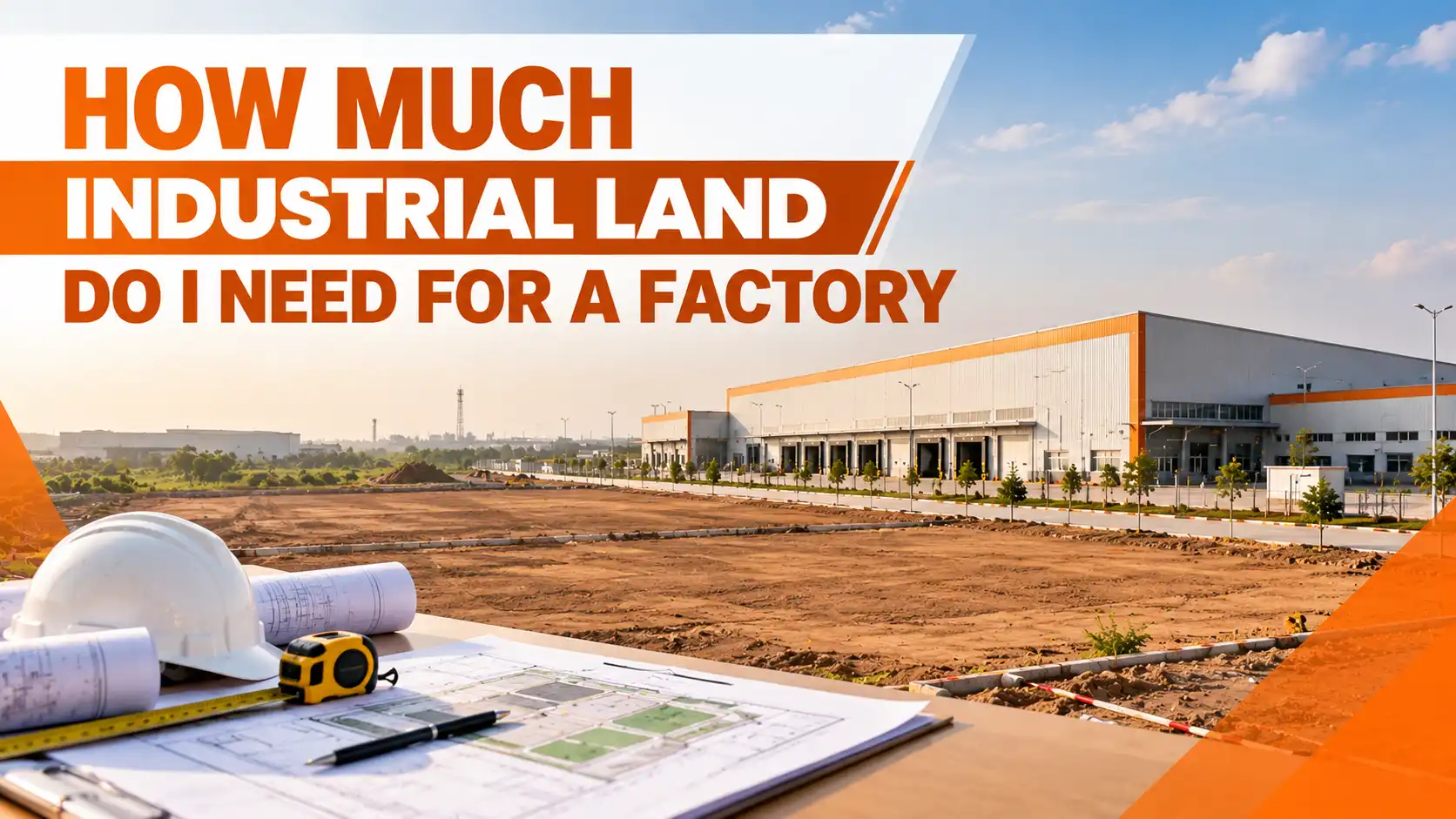
Your factory location is one of the most critical decisions in your planning. You will need enough land for your factory (production area), plant and machinery, storage of raw materials, storage of finished products, space for vehicle movement, utilities, and room for expansion. Buying less land can limit your operations.
However, if you’re looking to buy industrial land in Delhi, the ideal size depends on your production process, capacity, number of employees, storage needs, and applicable building codes. Calculate your needs and determine how much space your factory will need now and in the future.
Factors to Consider Before You Require Industrial Land for a Factory Purpose
Keep the following factors in mind before you need industrial land for a factory.
1. Start With Your Manufacturing Requirements
At Ganesh Complex, first determine what your factory will produce and what the development process will look like. For example, assembly may need less land for smaller models than a production plant for larger models with more equipment and truck traffic.
Identify your fundamental operational needs such as production lines, equipment, workstations, storage of raw materials, packaging, and processing of finished goods. Do you have needs for testing, quality control, or waste processing?
For instance, a small packaging unit can fit on a small plot of land. In contrast, a metal fabricating unit may require a larger plot for material storage, equipment movement, and loading.
Time your initial space estimate to actual production flow-don’t just choose a plot size that fits your budget.
2. Calculate the Space Required for Factory Buildings
Your factory building is just one component of the total land needed. You must also consider the area that cannot be built upon due to applicable setbacks, access roads, parking, fire protection requirements, and other development standards.
For a preliminary exercise in planning, a factor is the estimated anticipated built-up area, such as:
- Area of production
Space where machines, lines and stations are placed and where people move from one machine to another.
- Storage space
Space for raw materials, components, finished products, and packaging materials.
- Administrative Area
The administrative area includes offices, meeting rooms, amenities, and security.
- Utility area
Electrical installations, water installations, compressors, and other equipment.
The ultimate plot size must accommodate these devices while meeting the desired floor space, floor space ratio (FAR), setbacks, and building codes. These standards depend on the location and business zone, so test early before you buy.
3. Account for Storage and Inventory
Storage needs may also determine how much industrial land you need. Firms with lots of raw material or finished goods waiting to be shipped may need more space than factories that are fed and have little stock.
Calculate how much volume of materials you plan to store, how many days of inventory you will carry and the type of storage you will employ.
Consider the additional room required to safely handle and move storage containers if you store products on pallets, racks, in bulk, or outdoors. Think about any seasonal variance in customer demand that might temporarily increase levels of inventory.
With proper storage planning, you can avoid buying a too-large and more expensive plot of land to meet your storage needs while leaving space for your factory to operate!
4. Plan for Vehicle Movement and Loading
Factory vehicles such as trucks, delivery vehicles, forklifts and employee cars will need access to the site and to navigate around it. Packing off the site can delay loading, increase traffic, and limit space for movement.
Take into account the amount and dimensions of vehicles anticipated to access your site daily. Determine feasible loading bays, unloading zones, internal circulation pathways, parking spaces, and turning zones.
External space may be required for bigger manufacturing and logistics-dependent businesses may require external space, and premises that regularly receive substantial shipments of raw materials may also need it.
Check the approach roads to the industrial land for sale in Delhi, as well as the plot’s entry and exit setup. A larger plot can still cause problems if trucks can’t reach it.
5. Consider Future Expansion
Your land requirement should be based on your eventual business plans, not just your first batch. Anticipated future machinery, product range, storage requirements and labour force will mean extra space, saving you the need to move.
Leave some areas open for future buildings, site expansion, more lines, or additional utilities. Decide if the development potential of the property can help to support your growth plans.
Unique types of uses of industrial land may permit or restrict certain activities under planning regulations and local policies, so don’t assume all manufacturing, storage, and related operations are possible. Buy additional land only if an expansion plan makes sense and is financially justified; otherwise, good planning on a smaller lot pays off.
6. Estimate Your Land Requirement Before Buying
Use the following checklist to develop an initial estimate:
| Requirement | What to calculate |
|---|---|
| Production | Machinery, workstations, and manufacturing lines |
| Storage | Raw materials, inventory, and finished goods |
| Administration | Offices and employee facilities |
| Utilities | Power, water, drainage, and other infrastructure |
| Vehicle movement | Loading bays, internal roads, and parking |
| Safety and compliance | Setbacks, fire access, and mandatory open spaces |
| Future growth | Additional production and storage capacity |
Once you have already estimated these requirements, certainly consult an architect or industrial planning professional to translate your operational requirements into a compliant site layout.
7. Choose an Industrial Plot That Fits Your Budget
When you plan to compare industrial land for sale in Delhi, do consider the total cost of acquiring and developing the property rather than focusing only on its area or purchase price.
A smaller plot in a suitable industrial location can certainly reduce infrastructure and transportation expenses. A larger plot is appropriate if your production process requires extensive storage, planned expansion, and heavy equipment.
Verify the overall land title, permitted industrial use, access rights, utility availability, applicable approvals, and any development restrictions before committing to a purchase.
Conclusion
The amount of industrial land you will need for a factory will be based on your manufacturing process, types of buildings, storage needs, vehicle circulation, regulatory requirements and expansion plans. Work out the space you need for each of these and consult with a suitably qualified land agent to identify the right plot size for your needs.
If you certainly find the right industrial plot, it can support smooth production, keep development expenditure down, and allow room for business expansion.
FAQs
How do I estimate the industrial land needed for a factory?
Estimate production, storage, utilities, offices, vehicle movement, required open areas, development, etc., before selecting a plot size.
What influences industrial site size?
Land acquisition is required for manufacturing, machinery, inventories, building codes, transportation, utilities, growth, etc.
Questions to look into before buying Industrial land in Delhi
Verify land title, permitted industrial uses, development restrictions, road access, utility access, approval and cost of development.


