


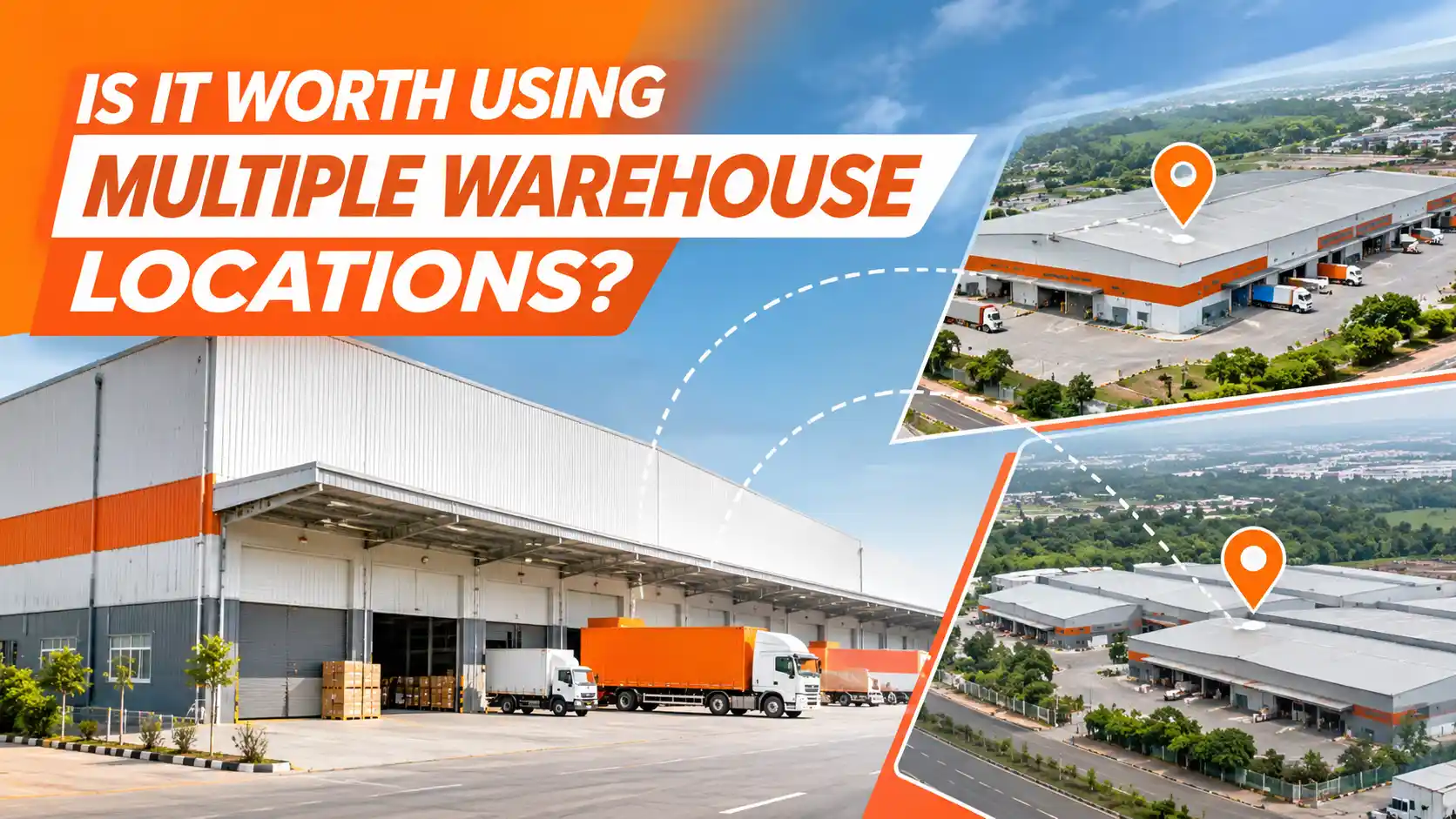
Yes. Some companies operate two warehouses- one in Delhi and another in Kolkata to ensure faster delivery and better access. But keep in mind that it depends on order volume, transportation costs, storage requirements, and your business’s long-term objectives.
1. Quick Delivery for Various Regions
One of the biggest advantages of decentralised warehousing is that you can get products to customers faster. By distributing your stock across the country, you reduce the time, effort, and cost of shipping products from a central warehouse. For example, a warehouse in Delhi can support Delhi NCR, Haryana, Punjab, Rajasthan, and UP. Conversely, one in Kolkata will help cater to the eastern market.
2. Reductions in Shipping and Transportation
Transport-related costs, such as fuel costs, shipping charges, and handling charges for goods that are transported across longer distances, may also be higher. Having more than one warehouse lets you optimise transportation management and inventory strategy.
Another opportunity is to optimise supply chain sourcing from the warehouse closer to the source/customer rather than from the main source. This may help reduce last-mile logistics costs. Nonetheless, companies should weigh up these savings against any added expense of managing several facilities.
3. Better Inventory Availability
Inventory at two locations enables a business to adjust better to local needs. A large number of orders for one location may negatively affect that location’s product levels, but another location would not.
A warehouse in Delhi and a warehouse in kolkata can also assist you in keeping regional stocks according to customer demands, seasonal considerations, and sales. On the other hand, you should maintain control of your inventory, avoid flipping it too much, and avoid overstocking.
4. A Wider Market Reach and Business Growth
At times, multiple warehouses let you reach new geographical locations without the burden of long-haul logistics. Organisations in North and East India can interlink warehouses in Delhi and Kolkata to access these geographies.
Your warehouses can also serve retailers, wholesalers, distributors, manufacturing companies, e-commerce companies, and MNCs in your region. Your conveniently located warehouses can also help establish local buyer relationships with suppliers.
5. Decreased Supply Chain Interruptions
Relying on one warehouse introduces operational risks. If there is a surprise delay in transportation, an equipment failure, a labour shortage, or a local disruption, the whole distribution process can be impacted.
More distribution centres offer flexibility; if a business has more than one site, it may be able to reconfigure or move orders if one site experiences an issue. This experience is inherent in the supply chain; however, it can give you a few added tools to help you thrive.
6. What Are the Challenges of Operating Multiple Warehouses?
While the benefits speak for themselves, managing warehouses across multiple locations requires significant planning.
Some common challenges include higher operating costs like rent, utilities, labour, security, and maintenance costs, which will go up when more facilities are added.
-
Complex inventory management
Accurate stock records are necessary for multiple locations.
-
Technology requirements
Systems for managing inventory, orders, and dispatch processes (a warehouse management system, or WMS).
-
Work coordination
Several operations need personnel.
-
Stock balancing
An eye on demand by region needs to be kept so that stock is neither piled up nor scarce.
Take these considerations into account before expanding warehouse operations.
7. How to Decide Whether Multiple Warehouses Are Worth It
Before opening multiple warehouses, consider your operation’s needs.
| Evaluation Factor | What to Consider |
|---|---|
| Order volume | Are there enough regional orders to justify another facility? |
| Delivery time | Will additional warehouses significantly reduce delivery time? |
| Transportation costs | Can regional storage reduce overall shipping expenses? |
| Storage requirements | How much inventory needs to be maintained? |
| Market demand | Are customers concentrated in different geographical regions? |
| Operating budget | Can the business manage additional warehouse expenses? |
| Transportation planning | It ensures the safe delivery of heavy components |
A cost-benefit analysis of the operation’s needs is required to show whether multiple warehouses are worth the investment in the long term.
Conclusion
Simply strategise for multiple locations; growing order volume, a widespread customer base, and consistent shipping needs make multiple warehouses a worthwhile investment. A warehouse in Delhi and a warehouse in Kolkata from Ganesh Complex would be a good business decision, as they would improve transit times and reduce processing delays.
Never support growth as it is based on real demand, supply chain logistics costs, and stock needs, not geographical expansion. The network of warehouses and locations must be flexible, with the right kind of logistics plan, supported by.


