


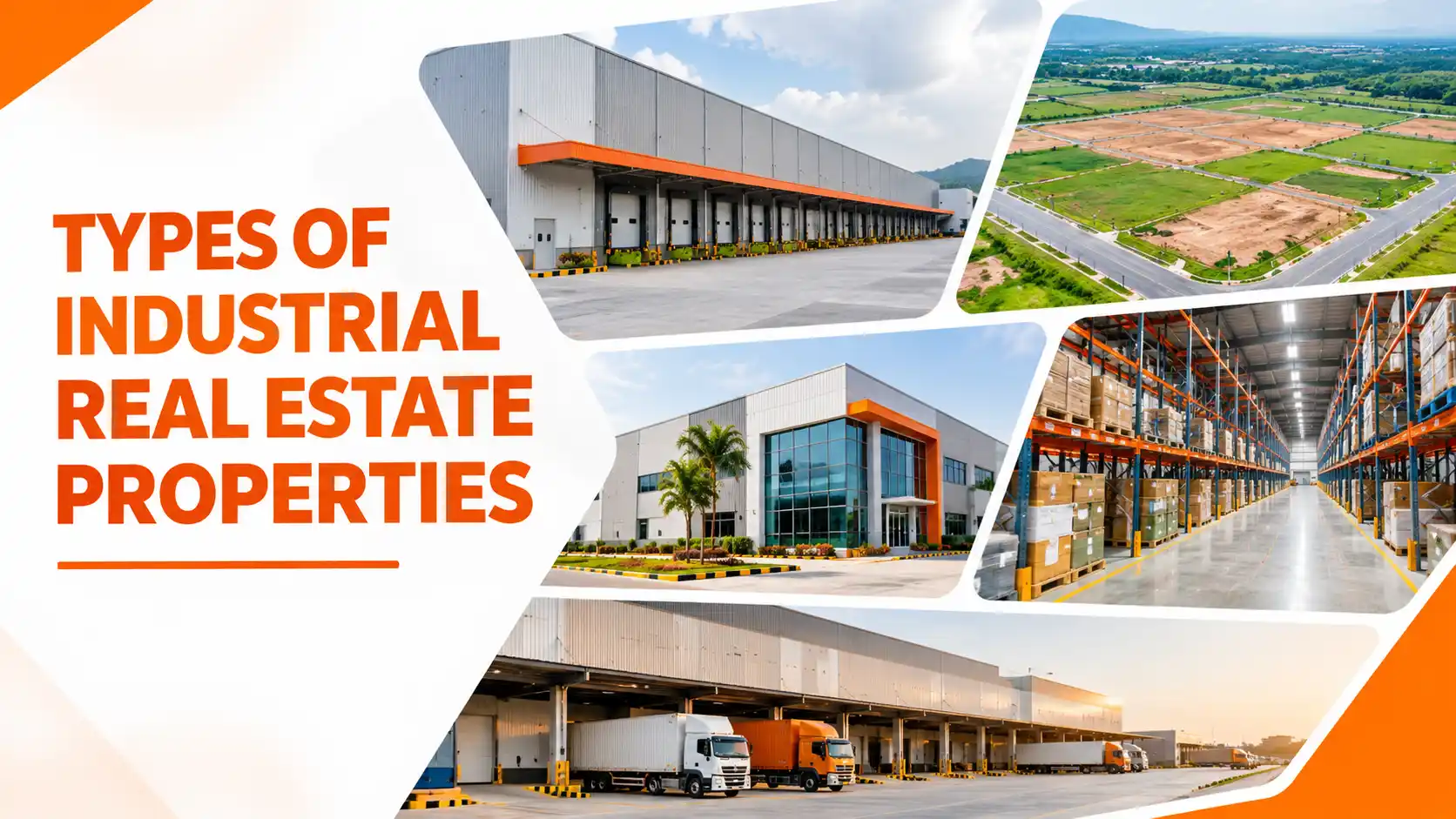
Most commercial real estate is built and developed exclusively for business activities. Just below it, the industrial property category is mostly used for manufacturing and distributing goods. Industrial property in Delhi comes in many shapes and sizes to suit different business needs.
Small industrial sites are mostly single- and double-storey buildings which are specifically allotted for all kinds of industrial usage. They mostly feature flexible interior space with a mix of warehouse and office space.
Large industrial property in Kolkata consists of medium to large warehouses and factories which are equipped for all sorts of manufacturing activities and storage of goods. At Ganesh Complex, larger big-box industrial spaces are used as distribution and logistics centres for holding and distributing various types of finished goods.
5 Types of Industrial Real Estate Properties
Real estate properties can be classified based on the building’s physical features and how it is used. Here are the key types of industrial real estate properties in Delhi.
1. Warehouse Distribution Industrial Properties
Industrial property in Kolkata accounts for about half of the city’s total industrial capacity. They are mostly used for warehousing and distributing business inventory. Warehouse properties range from 50,000 to hundreds of thousands of square feet and are usually single-storey structures.
They have ceilings up to 60 feet high, plus multiple loading docks, truck doors, and wide parking spaces for semi-trailers. Most office space is minimal.
2. Manufacturing industrial properties
At Ganesh Complex, manufacturing industrial properties in Delhi are the second-largest type of industrial property. These properties are designed to accommodate specialised equipment for large-scale production. This is why they include built-in infrastructure to support tenants’ heavy power and machinery needs.
They typically have clear heights of at least 10 feet and truck loading docks. Manufacturing industrial properties usually have three-phase, high-capacity electric power, plus high-capacity ventilation and exhaust systems.
3. The third category is Flex industrial properties
Flex properties can accommodate a wide variety of uses, typically more than one in a single facility, including office space, research and development, showroom retail sales, light manufacturing, and even small-scale warehouse and distribution.
Their configuration makes it easy for tenants to adjust the office-to-warehouse ratio to suit their business needs.
4. With technology becoming more advanced
As technology advances, the telecommunications sector is growing rapidly, and demand for advanced telecommunications facilities is rising. Because of their high power requirements, these specialised industrial buildings are usually located near major communication trunk lines and power supplies that can support extensive computer servers and telecom switching equipment.
Telecommunications facilities often contain scores of heavy yet compact pieces of equipment, backup generators, and specialised HVAC. They usually have reinforced floor slabs to support a high floor load per square foot.
5. Multi-Tenant Industrial Properties
Multi-tenant industrial properties are smaller facilities with more than one tenant. They suit small- to mid-sized businesses. They cater to the growing demand of small- and mid-sized service-oriented businesses and can add space as needed by incorporating additional space within the same building.
Most of these properties are quickly catching up to other in-demand industrial property types.
Bottom Line
For most stakeholders, understanding industrial real estate features and typologies is key before entering the field. New and upcoming businesses should contact the best industrial real estate developer once they have decided on their business-specific space requirements.
A suitable industrial property is arguably the finest starting point for kick-starting a flourishing business.
Frequently Asked Questions
1. What are the different types of industrial real estate properties?
Common industrial property types include Warehouse and distribution properties, manufacturing properties, Flex industrial properties, Telecommunication properties, and Multi-Tenant industrial properties.
2. How do I choose the right industrial property for my business?
Before choosing an industrial property, consider how you plan to run your business, how much industrial space you need, power, Storage, transit, and your budget.
3. What is the difference between warehouse and manufacturing industrial properties?
Warehouses are primarily for storage and dispatch. Manufacturing facilities are for machinery, production, and specialised industrial equipment.
4. What are flex industrial properties used for?
Flex industrial includes office space, light manufacturing, research and development, showrooms, and small-scale warehousing.
5. Where are the industrial spaces in Delhi and Kolkata?
Search for industrial property in Delhi and Kolkata on top industrial property developers’ websites and commercial property portals.


