


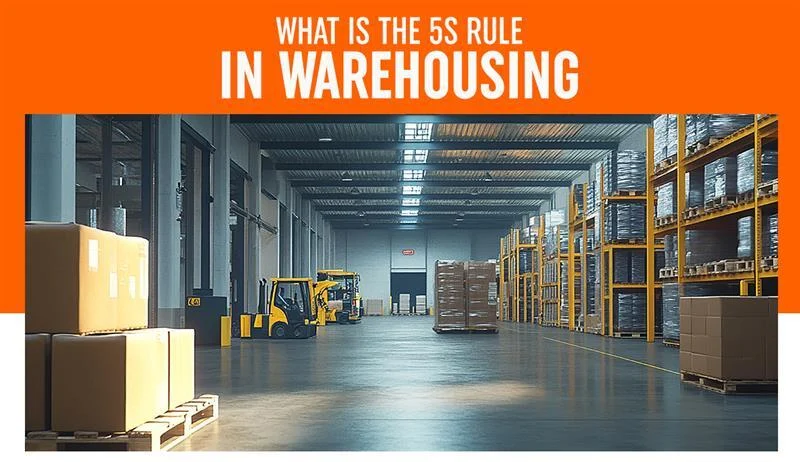
In the realm of warehousing and logistics, efficiency and organisation are critical factors which contribute to its success. One of the renowned methodologies that promotes these qualities is 5S.
Now, what exactly is 5s in the context of a warehouse in Kolkata, and how can it really benefit your overall operations. In this blog, we explore the concept of 5S, its full application in warehouse management, and the positive impact it can really have on your business.
Understanding 5s
5S is a methodology that originated in Japan and focuses primarily on workplace organisation and standardisation. The name 5S is derived primarily from five Japanese terms: Seiri (Sort), Seiton (Set in Order), Seiso (Shine), Seiketsu (Standardise), and Shitsuke (Sustain).
Each of these respective steps plays a critical role in streamlining processes and improving the overall efficiency.
The Five S’s
Sort (Seiri)
According to the experts at Ganesh Complex, the first step in 5S involves decluttering the workspace and removing unnecessary items. As a result, by eliminating these items that are not essential to daily operations, you create a more organised and functional environment.
This sorting process helps identify frequently used items, items that could be stored elsewhere, and those that are already discarded.
Set in Order (Seiton)
Once you remove the unnecessary items, the next step is to arrange the remaining items in a logical, most ergonomic manner.
This kind of step is all about effectively organising the workspace to minimise wasted time and effort with equipment, locating tools, and materials. Therefore, implementing storage systems, shelving, and labelling is critical to ensure items have designated places.
Shine (Seiso)
This step completely emphasises the significance of cleanliness and maintenance. Regularised cleaning and inspection of equipment and workspaces help you identify potential issues early and prevent minor accidents and breakdowns. You must maintain a clean and tidy environment of warehouse in Kolkata to ensure the smooth functioning of daily operations.
Standardise (Seiketsu)
According to the experts of Ganesh Complex, establishing standardised procedures and practices is critical for consistency. This step ensures everyone follows the same protocols, leading to improved efficiency and reduced errors. Standardisation helps create uniformity across warehouse operations and prevents variations in overall processes.
Sustain (Shitsuke)
However, sustaining the improvements achieved through 5S requires ongoing commitment and discipline. Therefore, regular training and reinforcement of the 5S principles will help maintain an organised and effective warehouse management system. Sustaining 5s is an ongoing process which requires continuous monitoring and the involvement of all employees.
Benefits of 5S
However, implementing 5S in a warehouse does offer several benefits that positively impact your business.
-
Improved Efficiency
Thus, by eliminating waste and optimising workflows, 5S reduces lead times and increases productivity. Therefore, employees can easily find tools and materials, leading to seamless operations and faster order fulfilment.
-
Enhanced Safety
A well-organised warehouse minimises hazards and promotes a safe working environment for all employees. As a result, reduced clutter and clearly marked pathways help prevent accidents and injuries. Better Organization
5s fosters systematic organisation, ensuring that materials and tools are quickly accessible, saving both time and effort. As a result, well-established different types of warehouses storage areas do lead to less inventory damage and loss.
Implementing 5S
Therefore, the successful implementation of 5S does require a structured approach.
-
Conducting a 5s Audit
Simply begin with a comprehensive assessment of your warehouse’s current state. As a result, identify areas that require improvement and set goals for the 5S implementation process. A 5S audit involves evaluation of each S (Sort, Set in Order, Shine, Standardise, and Sustain) and rating the warehouse’s performance in each category.
-
Examples of Floor Marking
Do utilise floor making as a specific visual aid for organising storage areas, walkways, and workstations. It is the unique colours that represent particular zones, enhancing organisation and safety. It is the floor maintenance that helps maintain the “Set in Order” aspect of 5S, ensuring that everything is in its designated place.
The Importance of 5S
It creates a culture of continuous improvement, which is critical to the success of all kinds of businesses. Therefore, 5S plays an essential role in optimising warehouse operations and nurturing a mindset of efficiency and effectiveness.
Training Employees
To ensure the fruitful adoption of 5S principles, comprehensive training programs are provided to employees. Therefore, educate staff on the importance of 5S and involve them in the process to instil a sense of ownership and responsibility.
Therefore, the training sessions should always cover each S of 5S and how it contributes to different types of warehouses optimisation.
Challenges and Tips
While implementing 5S leads to huge improvements, it never comes without challenges.
-
Resistance to Change
Most employees might be resistant to new procedures. Do encourage open communication and provide ample support during the transition. Try to explain the benefits of 5S and how it can improve their work environment.
-
Maintaining Consistency
However, sustaining the improvements achieved through 5S can be really challenging. However, regular enforcement and periodic audits are critical to maintain progress. Do ensure that everyone remains committed to the 5S principles and actively participates in the overall ongoing process.
Measuring Success
Therefore, measuring the success of your 5S implementation is critical to evaluate its effectiveness.
Track Key Metrics
However, do monitor metrics such as productivity, inventory accuracy, and safety incidents to gauge the impact of 5s. As a result, comparing data before and after 5S implementation will help you identify improvements and areas that require significant attention.
Bottom Line
According to Ganesh Complex experts, 5S is a robust methodology that transforms warehouse operations. Thus, by embracing the principles of Sort, Set in Order, Shine, Standardise, and Sustain, businesses do achieve higher efficiency, improved safety, and better organisation. Furthermore, a successful implementation requires dedication, training, and ongoing commitment to maintaining the 5S culture. Get in touch with us for more information.


