


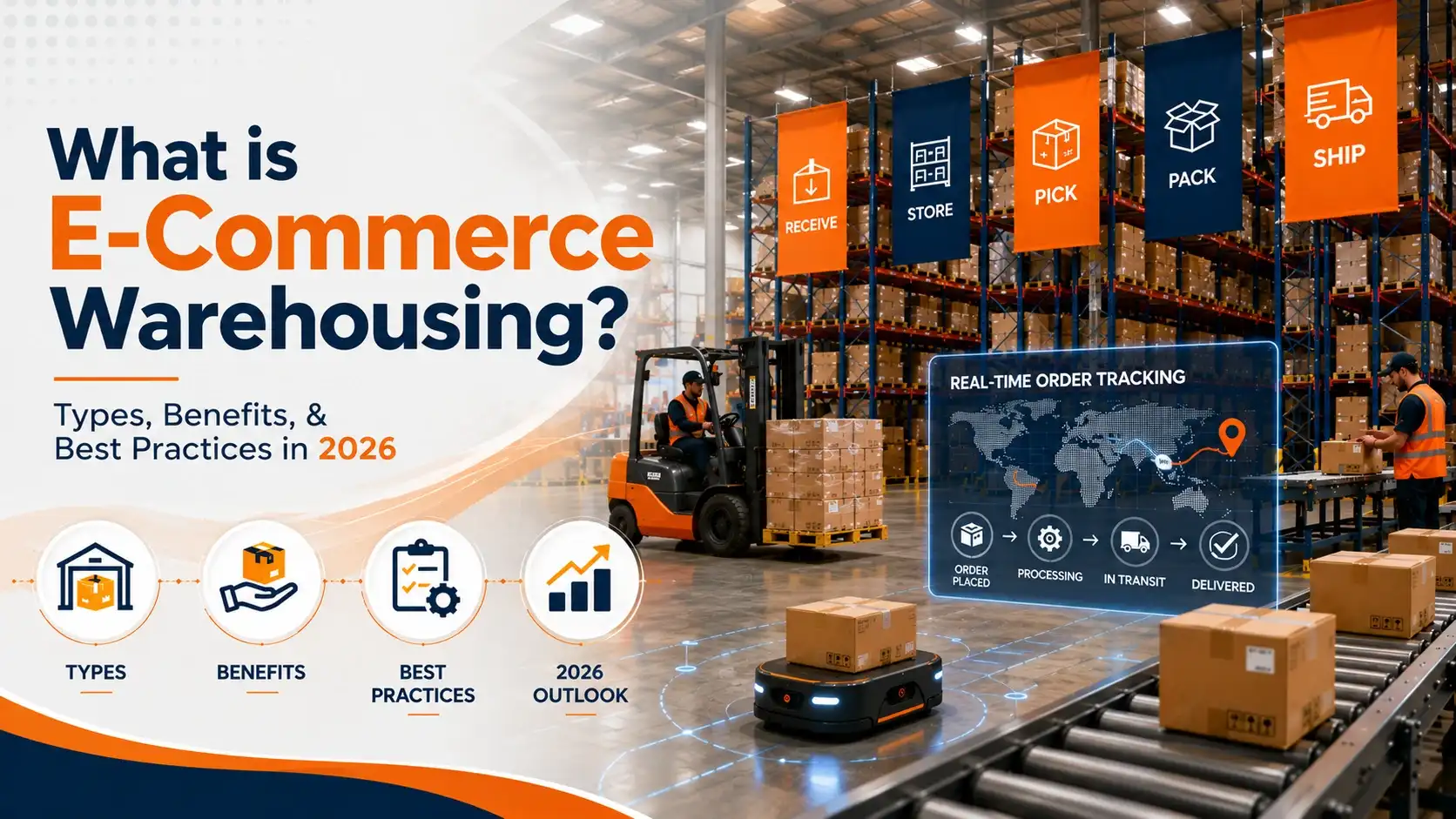
Every order placed on the ecommerce platforms sets off a chain of events that customers never see. Behind every on-time delivery is a warehouse toiling at speed, stocking inventory, tracking stock, packing orders, and making delivery possible within the tightest possible window. Ecommerce is that invisible engine behind these activities. Now, in 2026, the e-commerce warehouses have become one of the most critical components for online businesses in India.
India’s e-commerce logistics market is valued at USD 7.25 billion in 2026 and growing at a CAGR of nearly 9%. With same-day and next-day delivery becoming the norm today, the way products businesses arrange and store their inventories has become a front-line business decision. The blog breaks down the ecommerce warehousing concepts you need to know, covering its benefits, types, and best practices.
What is E-Commerce Warehousing?
E-commerce warehousing is the process of storing, organising, and managing products sold through online platforms. The system dispatches those goods accurately and quickly to the end customer. Ecommerce warehousing differs critically from traditional warehousing. A modern e-commerce warehouse relentlessly works on the core operations mentioned below:
- Receives new inventory and organises it by category, and storage zone
- Tracks real-time stock tracking through
- Picks items from shelves based on orders
- Packs orders safely with the right materials and documentation
- Dispatch shipments through logistics and courier partners
- Processes returns, restocking goods, and managing reverse logistics
As of 2026, the meaning of the term ‘e-commerce warehousing‘ will continue to expand. Today’s warehouses also integrate technology with sales platforms, barcode and RFID-based inventory control systems, and eco-friendly operational practices. The warehouse serves as the central hub for order fulfilment.
Benefits of E-Commerce Warehousing for Online Businesses
Investing in the right e-commerce warehouse brings measurable upsides, including cost, speed, customer satisfaction, and scalability.
- Faster Delivery Times
The warehouse location is directly linked to how fast a product is delivered. A warehouse located close to highway corridors, freight hubs, and urban delivery zones provides faster delivery. For online sellers, this is what makes the difference between receiving five-star ratings and having cancellation requests.
- Lower Logistics and Operating Costs
Businesses pay only for the actual space and services used, thereby reducing overhead costs. This is one of the major benefits for new or growing brands with random order quantities.
- Real-Time Availability of Inventory
According to records, Indian e-commerce businesses lose 4-8% of their annual revenue to stockouts. The WMS enables warehouses to provide live data on stock levels for every SKU, which products are subject to reordering, and reorders to reduce overstocking and errors in filling orders.
- Ability to Scale Up/Down During Peak Seasons
Seasonal sales peaks like Diwali, Big Billion Days, or New Year Clearance amplify businesses’ need for short-term storage. Logistics parks allow businesses to either increase or decrease their storage needs without incurring relocation costs.
| Benefit | Key Information |
|---|---|
| Faster Delivery | Warehouses near highways and delivery hubs help products reach customers faster. |
| Lower Costs | Businesses pay only for the space and services they use, reducing operating costs. |
| Live Inventory Tracking | Real-time stock updates help prevent stockouts, overstocking, and order mistakes. |
| Flexible Storage | Storage space can be increased or reduced during seasonal sales without relocation. |
| Easy Returns Management | A structured warehouse process handles returns quickly and improves customer satisfaction. |
-
Customer Satisfaction with Easy Return Policy
Returning a policy is not a minor issue in Indian e-commerce. It accounts for 20-30% of total order fulfilment volume across fashion, electronics, and many other categories. A warehouse with a structured process handles returns faster and nurtures a loyal customer base in the long run.
Types of E-Commerce Warehouses
There is a range of warehouse options available based on different business needs and demands. The ideal e-commerce warehousing offers top-tier amenities and expertise. Along with this, these also allow brands to store inventory in strategic locations to make the delivery fast and cost-effective. Let’s look at the most popular ecommerce warehouse types and which businesses they suit the best.
- Warehouse on Lease (helps businesses with a warehouse management system to manage their inventory in real time)
- Warehouse from Home (where a small business owner stores the inventory at home before shifting to a commercial warehouse)
- Bonded warehouses (Goods are stored here before inspection and customisation)
- Distribution Centres (It’s an ecommerce warehouse that receives and stores the inventory, picks and packs, and dispatches the order on time)
- On-demand warehouses (These warehouses help businesses with needed storage space for a temporary period of time)
- Dropshipping ( a supply chain that the manufacturer entirely controls)
| Warehouse Type | What It Does |
|---|---|
| Warehouse on Lease | Leased warehouse with inventory tracking and warehouse management support. |
| Warehouse from Home | Small businesses store products at home before moving to a larger warehouse. |
| Bonded Warehouse | Stores imported goods before customs clearance and inspection. |
| Distribution Centre | Receives, stores, packs, and ships orders to customers. |
| On-Demand Warehouse | Provides temporary storage space when extra capacity is needed. |
| Dropshipping | The supplier stores and ships products directly to customers. |
Best Practices for E-Commerce Warehousing in 2026
- Leveraging Warehouse Management System
A Warehouse Management System (WMS) is key to any modern e-commerce operation. A WMS provides real-time inventory data; automates order procedures; monitors the warehouse productivity; and reduces errors associated with the picking and packing of customer orders. The WMS market is predicted to reach $10.6 billion by 2030.
- Creating A Standard Operating Procedure
Reverse logistics is a first-class operation, rather than an afterthought. Clearly mark an area within the warehouse for returns. Establish a standard operating procedure (SOP) for restocking returned product or writing off damaged product. Track return rates by SK to turn a cost centre into revenue recovery.
- Selecting a Site Based on Your Clients
Location is the most important factor in reducing last-mile transportation costs and quickening delivery times. It enables the warehouse to be closer to its customers. For businesses based in the eastern part of the country (West Bengal, Bihar, Jharkhand, Odisha, and the northeastern states), a warehouse facility along the Kolkata-Howrah logistics corridor is highly strategic.
- Giving Priority to Protection, Sustainability, and Compliance
Grade A warehouse facilities now incorporate a range of security measures, including 24-hour CCTV monitoring, fire-suppression systems, perimeter security, and construction that aligns with the highest eco-friendly building standards. As ESG (environmental, social, and governance) responsibilities become more important in B2B procurement decisions, warehouse partners with sustainable practices equip the businesses with an edge to serve corporate clients or operate in export markets.
| Best Practice | Key Information |
|---|---|
| Warehouse Management System (WMS) | Provides real-time inventory tracking, faster order processing, better warehouse control, and fewer packing mistakes. |
| Returns Management | Set up a dedicated returns area and follow a clear process for restocking or disposing of damaged items. |
| Warehouse Location | Choose a site close to customers to reduce delivery costs and improve delivery speed. The Kolkata–Howrah corridor is ideal for serving Eastern India. |
| Security & Compliance | Look for warehouses with CCTV, fire safety systems, perimeter security, and eco-friendly infrastructure. |
How to Choose a Reliable Warehouse Solution in Kolkata?
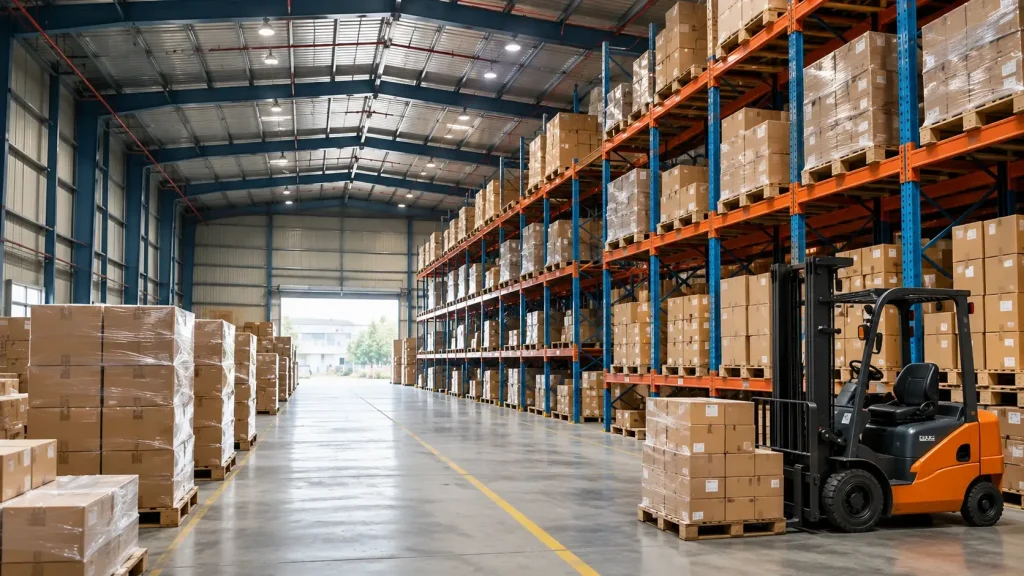
Kolkata is no longer simply an eastern logistics hub, for it is fast taking the leadership role. The city’s nearness to Haldia and Kolkata ports, multimodal connectivity to national freight corridors, and gateway access to Bangladesh, Bhutan, Nepal, and the Northeast make it a uniquely strategic warehouse location for businesses targeting eastern India and beyond.
Here are what you need to see in any of your warehousing partners in Kolkata:
-
Strategic Location and Highway Connectivity
Warehouses situated along NH-6 (Bombay Road) and NH-19, with direct access to Kolkata, Howrah, and the national freight system, are located on or near these roads. The Howrah-Hooghly region, consisting of Dankuni, Uluberia, Panchla, Sankrail and Ranihati, is rapidly becoming the most active and fastest growing warehousing corridor in eastern India. Finding warehouses within this corridor significantly reduces both inbound freight costs and the time required to dispatch to customers from the last mile.
-
Infrastructure Quality and Amenity Standards
Evaluate the infrastructure amenities/qualities below to ensure functionality:
- Strong flooring that supports the weight of heavy rack systems
- Sufficient ceiling height is required for multi-tiered storage options
- Wide enough truck bays that allow for simultaneous loading/unloading
- Fire safety requirements that comply with regulations
- If cold storage capabilities exist, they would be an added benefit for FMCG, pharmaceutical, and perishable goods.
-
Flexible Unit Sizing and Lease Terms
The way we store products varies over time based on the nature of our business. The process continually evolves with expansion. A flexibly-sized unit logistics park helps your business grow by offering flexible-sized units for business and/or commercial use. Moreover, if your business is expanding, you will require a range of lease options from short-term to long-term.
- WMS (Warehouse Management Software) Integration
You should check whether your current logistics provider has integrated technologies such as WMS, barcode scanning, and RFID tracking with your e-commerce and ERP platforms. This integration will allow you to improve accuracy, reduce handling time, and increase online visibility for your e-commerce brand.
- Established with Reliable E-Commerce Brands
If you have the opportunity to use a Logistics Park with a track record of accommodating major e-commerce brands (e.g., Amazon/Flipkart), you will feel more confident. The park is properly maintained and meets the standards for safe operation and an appropriate management structure.
Final Takeaway
As you expand eastward, collaborating with a warehouse provider in Kolkata will determine your success. Our buildings meet industrial specifications and offer modern features and flexible lease terms. As the chosen warehousing partner for many of the largest retailers operating today (Amazon.com, Flipkart, Snapdeal, Kirloskar, and DHL), we offer facilities designed for today’s e-commerce businesses. Contact our representative at Ganesh Complex today for further discussion.


