


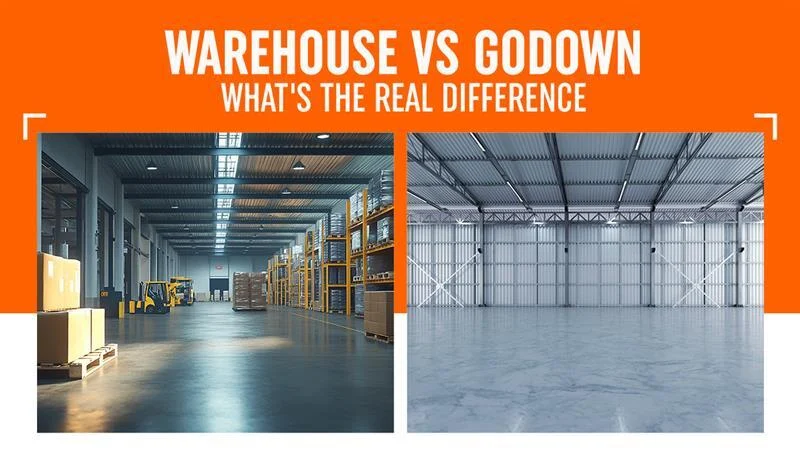
Several people in the storage, logistics, supply chain, and operations world often miss the fine distinction between a warehouse and a godown. Sometimes, they both appear to be ordinary storage spaces, but they do serve unique functions. Each of them has its own unique purpose, structure, and function, even in business operations.
We at Ganesh Complex are well aware that the correct storage environment is critical for all your goods. The storage space you select has a significant impact on your supply chain speed, operational costs, and even customer satisfaction.
As a result, understanding the difference between a warehouse and a godown isn’t just about having information; it is a practical business decision that requires careful consideration. This blog covers everything you need to know to select a warehouse for sale in Kolkata that supports your growth.
Why Understanding the Difference Matters?
All businesses, regardless of their size, nature, or industry, like large, small, retail, manufacturing, and e-commerce, definitely require reliable storage solutions. Thus, opting for an inappropriate facility results in problems such as inventory loss, delivery delays, and increased shipping costs.
Therefore, understanding the difference between warehouse and godown is critical in this specific context. While both these storage facilities hold goods, the levels of organisation, technology, and security provided in them aren’t comparable.
One is optimised for efficiency and traffic, while the other simply serves as a place to store all kinds of goods and save on costs. Do unfold these concepts in a manner that is simple and yet practical to understand.
What is a Warehouse?
At Ganesh Complex, our expert believes that a warehouse is a sizeable building where a massive number of products are stored and serves as a comprehensive system for seamless operation, management, and organisation.
Modern technology enables the efficient movement, handling, and transportation of goods. This day, warehouse for sale in Kolkata play an essential role in supply chains, and this is mainly important for business that require quick access, precise inventory control, and full visibility.
Some of the characteristics that define the modern warehouse are:
- While the use of contemporary inventory systems like WMS, RFID, and barcode scanning
- Planned racking and shelving for organised storage
- Safety measures, which consist of CCTV, trained personnel, and a fire prevention system
- Some of the value-added services consist of labelling, packaging, kitting, and cross-docking
- Temperature control for food and other perishable and sensitive items
- A warehouse is designed for efficiency, accuracy, and effectiveness.
- Mainly, it assists in order fulfilment, minimises the delivery times, and offers full-fledged support to fast-growing companies, especially those in the e-commerce, FMCG, retail, pharmaceutical, and manufacturing sectors.
What is a Godown?
On the contrary, a godown is an old-fashioned, no-frills storage space widely used in Kolkata. Where the warehouse is a totally organised home, the godown is more of a basic storeroom, practical, functional, and economical. The primary concern of a godown is to ensure that the goods aren’t only kept dry but also that there are no problems with organisation or quick movement.
Some of the common traits of a Godown are:
- Simple construction structure
- Bulk goods are mainly stored without any kind of racks
- Minimal security systems
- Lower rental and operational costs
- Ideal for raw materials, grains, bulk goods, and slow-moving items
Godowns’ major users are local traders, wholesalers, small enterprises, and farmers. They do require low-cost storage, which is free from the encumbrance of sophisticated logistics.
How to Choose Between a Warehouse and Godown?
Some of the differences between Warehouse and Godown are as follows. To decide which one suits your business, definitely consider the factors below. Therefore, your decision between a warehouse and a godown will depend mainly on the nature of your goods and your long-term operational requirements.
1. Type of Goods
A warehouse is the best option if your product requires tracking, monitoring, temperature control, safety, dispatching, and other similar services, as their systems are the most advanced. A godown is ideal for storing dirty, non-sensical, or large raw materials, keeping them organised and cost-effective.
2. Inventory Volume & Movement
Most companies handle a large volume of products, operate continuous dispatching, or work with cities like Kolkata. Therefore, it will find warehouses very advantageous, as it can utilise a robust infrastructure. On the other side of the equation, there are godowns, which serve as storage facilities for slow-moving goods and seasonal stocks that don’t require quick handling.
3. Budget
Warehouses might be costly, but they definitely leverage technology to provide accuracy and precision. If your primary requirement is storage at a lower price with no additional services, a godown can be the best solution.
4. Growth & Scalability
If a company is expanding or trying to operate faster, it chooses warehouses because they are built with scalability in mind. Godowns are well-suited to gradual, traditional businesses with limited expansion needs.
5. Safety, Compliance & Documentation
While strict safety standards and mandatory compliance protocols in industries like electronics, pharmaceuticals, FMCG, food, and export are the reasons these industries mainly utilise warehouses.
Expert perspectives of Ganesh Complex
At Ganesh Complex, we help companies select storage solutions that aren’t only effective today but also future-ready. The factors we look at are as follows.
- Your industry
- The type of your products
- Your way of working
- Cost and budget
- Future expansion possibilities
Therefore, the correct choice will yield similar results as mentioned, like efficiency, cost reduction, and supply chain strengthening, regardless of whether it is a high-tech warehouse or a basic godown that your business requires. Therefore, knowledge of what a warehouse and godown are will undoubtedly assist in making this specific decision.
Conclusion on the Difference Between Warehouse and Godown
The primary distinctions between a warehouse and a godown are mainly based on its functions, building materials, technologies that are used and the position that it takes within the supply chain as well.
A warehouse enables systematic, technology-based operations that ensure a smooth, rapid distribution process, efficiently addressing modern logistics challenges.
While a godown serves as a basic, lower-cost solution for wide storage of goods that require minimal processing, the priorities of your organisation will mainly decide the choice that you opt for, like fast, effective, and professional services or cheap and straightforward operations. Therefore, with Ganesh Complex, you will find the most eco-friendly, efficient, and scalable storage solution that enables your business to operate reliably and smoothly while preparing for future expansion and growth. For more information contact us.


