


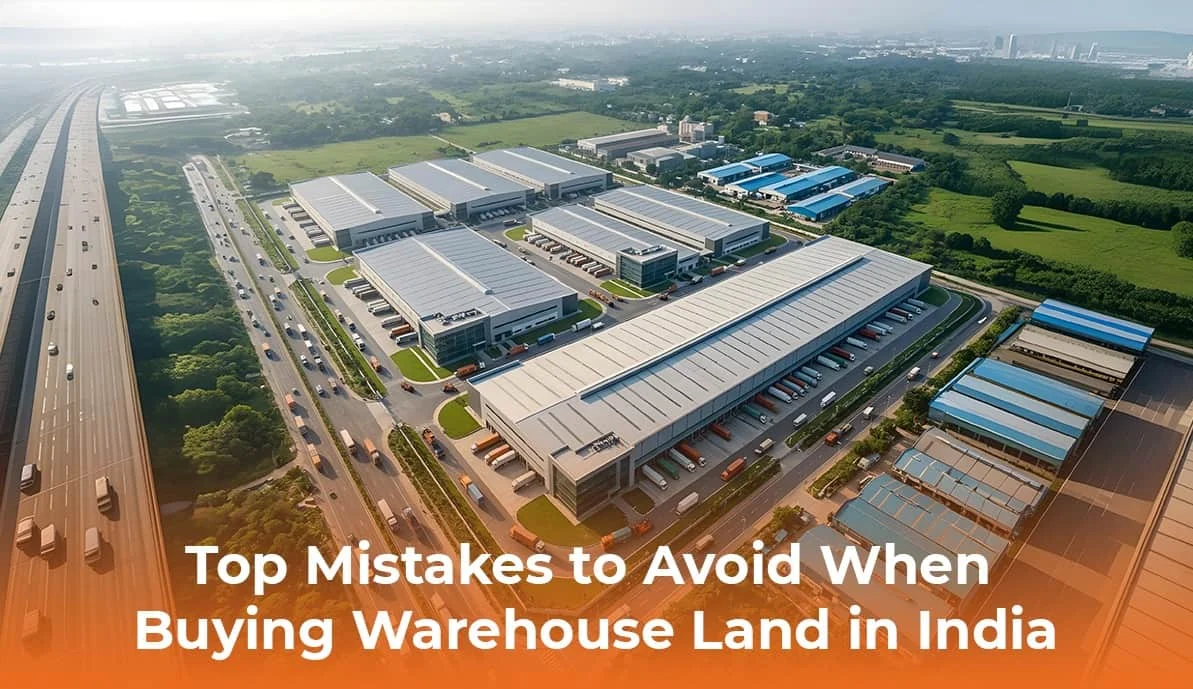
While the demand for warehouse infrastructure in India has grown over the past few decades, it is mostly driven by e-commerce, manufacturing, retail, and logistics expansion. Whereas, investors and businesses are mostly searching for suitable industrial plots just to develop modern storage facilities.
So, whether you’re planning a logistics park or a good warehouse in Kolkata, you need to plan and conduct due diligence when acquiring warehouse land. Financial losses, legal disputes, and poor performance most often follow a wrong decision.
Top Mistakes to Avoid When Buying Warehouse Land in India
Top mistakes to avoid when purchasing warehouse land in India.
Ignoring Location Connectivity
The biggest mistake buyers make is choosing land purely on price, while ignoring connectivity. A warehouse is strategically located near highways, ports, railway terminals, and industrial corridors. Poor accessibility increases both transportation costs and delivery delays.
An example of this is that if a company is sourcing a warehouse in Kolkata, then surely proximity to NH16, Raghudebpur, Ranihati I, Ranihati II, Uluberia, and Ranihati I Phase II logistics hubs, and Kolkata Port will be important in the selection. Good accessibility will directly lead to easier operation and greater appreciation of the property.
Not Verifying Land Titles
You will need to conduct a legal check before purchasing any industrial property. Most buyers ignore title checks and then end up in litigation over land ownership and use. Make sure the seller is the legal owner.
Therefore, you should always hire a legal expert to verify the following:
- Encumbrance certificates
- Ownership documents
- Mutation records
- Government approvals
- Pending litigations
Skipping this step can definitely lead to serious legal and financial troubles in the future.
Overlooking Zoning and Land Use Regulations
Not every piece of land can legally be used for warehouse construction. Several investors can assume they can convert agricultural or residential land to industrial use later. But the overall process can be very expensive and time-consuming.
Before buying, confirm that the land falls within the approved logistics and industrial zoning. While local development authorities and municipal regulations should certainly permit warehouse activities. It is important in fast-developing regions, where land-use policies are constantly changing.
Ignoring Infrastructure Availability
According to the experts at Ganesh Complex, a warehouse operation relies heavily upon supporting infrastructure. Buyers focus not only on land size, but also forget to check the following:
- Supply of water
- Quality of the road infrastructure
- Availability of electricity
- Connectivity of the Internet
- Drainage systems
Without proper infrastructure, warehouse development costs can certainly rise significantly. Businesses planning a warehouse in Kolkata will carefully assess flood resistance and transportation infrastructure, taking into account the specific region’s weather conditions and urban traffic patterns.
Underestimating Future Expansion Needs
Businesses often purchase land with only immediate operational needs in mind. As operations grow, they quickly realise the space does not allow for future expansion. When purchasing warehouse land, do keep in mind potential growth for:
- Cold storage units
- Loading bays
- Truck parking
- Future warehouse extensions
- Employee facilities
While planning for expansion, save on relocation costs from the beginning.
Not Evaluating Soil and Environmental Factors
The quality of the ground influences the construction cost and the safety of the warehouse. Usually, sellers do not conduct soil testing or environmental surveys, and the foundation construction cost will be higher in the future.
Do conduct technical inspections only to examine the following.
- Risk of floods.
- Stability of the soil.
- Risk of waterlogging.
- Obtaining the environmental clearances.
- Pollution restrictions.
An industrial warehouse must be structurally sound to support the weight of large machinery and racks.
Opting for Price rather than the strategic values
When buying land, the cost is the main factor, with potential business value overlooked. Buying cheap land could be the worst deal if the place doesn’t have potential for a logistics business, so always take a long-term view while purchasing land rather than just the acquisition cost.
Warehouse could give a high return in the long run, through increased connectivity, reduced transport costs and higher rentals than the cheap undeveloped locations.
Not understanding the market demand.
In many situations, people have bought warehouse land without considering the current warehouse demand. Industrial development, the E-commerce sector, and the transport sector play an important role in the demand for warehouses.
Carry out detailed studies with the above criteria.
- Industrial corridor expansion.
- Upcoming infrastructure.
- Demand for logistic parks.
- Regional manufacturing growth.
When discussing the different types of warehouses, land selection should primarily consider sustained demand.
Skipping Professional Guidance
While some buyers try to manage the entire transaction independently just to save money. While warehouse land purchases certainly involve technical, financial and legal complexities.
While working with experienced professionals, the following are as follows
- Legal advisors
- Real estate consultants
- Surveyors
- Tax experts
It can help you to identify hidden risks and even improve decision-making.
BottomLine
The purchase of warehouse land in India is a major investment; thus, it is important to analyse and evaluate the options. Hence, errors in legal verification, infrastructure evaluation, location analysis, and future planning can result in substantial losses for individuals or businesses. Hence, whether the deal is about investing in a logistics hub or planning a warehouse in Kolkata, thorough due diligence is of paramount importance.
A successful warehouse land investment requires smart location planning, legal validity, robust infrastructure, and scope for growth. Such mistakes can be avoided if done correctly, and businesses or individuals looking to invest in warehouse land in India can build such warehouse operations. For more details connect with us today!


