


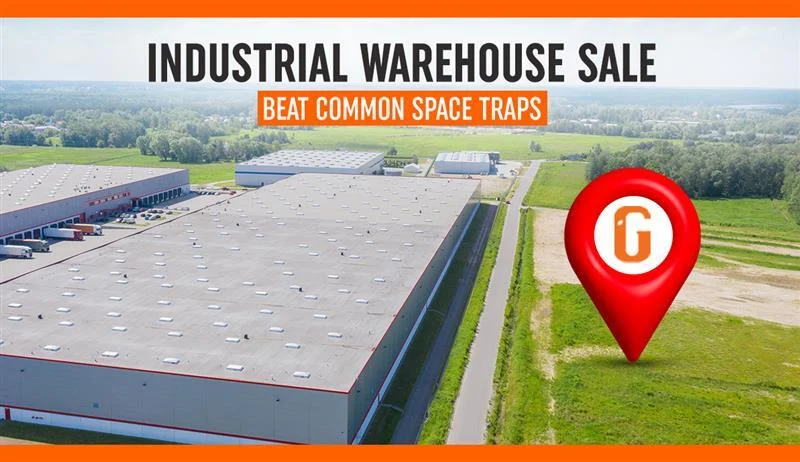
Manufacturing, eCommerce, and logistics has accelerated the demand for ‘industrial warehouses for sale’ – creating intense competition among buyers. The majority of buyers will typically place greater emphasis on ‘location’ and ‘price’. However, one often overlooked consideration is how the warehouse or distribution centre’s facilities and lay-out affect the performance of the various day-to-day activities performed within them.
Choosing the wrong warehouse layout for size definitely leads to long-term inefficiencies that drain profits. You are required to understand common space-related pitfalls before finalising a purchase, which helps businesses avoid costly mistakes and build a facility that supports growth, efficiency, and compliance from day one.
Understanding the Importance of Smart Warehouse Space
A warehouse in the industrial sector has purpose and meaning beyond simply being a location to store goods, with its central hub functions being primarily the driving forces of inventory management, employee productivity and logistics. “Making poor use of your physical layouts will create congestion,delay and create operational bottlenecks”, say Ganesh Complex expert team members.
Businesses that rush into buying an industrial warehouse without assessing the spatial requirements struggle to adapt their operations later. A well-planned warehouse, on the other hand, enables smooth material movement, optimised storage systems, and seamless coordination between both inbound and outbound logistics.
Common Space Traps Buyers Should Avoid
The most common mistake when purchasing an industrial warehouse for sale is underestimating its future needs. Most businesses select a warehouse that fits current operations but leaves no room for expansion. According to the experts at Ganesh Complex, as demand grows, limited space forces inefficient stacking, overcrowded aisles, and compromised safety standards.
One of the most common traps is a poorly designed layout. Warehouses with oddly shaped containers, limited access points and poorly located loading docks will often slow down material handling and increase labour costs. Having insufficient clearance for the use of modern racking systems is also another serious problem.
Ignoring support areas such as packing zones, quality checks, employee facilities, and equipment storage can lead to all kinds of operational stress. These overlooked elements definitely become the root cause of long-term warehouse inefficiencies.
-
Location and Accessibility Matter
Even a spacious warehouse can become inefficient if it really lacks proper connectivity. The time to deliver goods and the cost of logistics because of your distance from highways, ports, and transportation centers has a tremendous impact on how fast and efficiently you can move the goods. In order to successfully run a high volume operation, it is important that your location has truck access, loading docks/bays, and enough internal space for vehicles to move around safely.
When reviewing an industrial warehouse, consider whether or not the surrounding infrastructure supports effective vehicle movement and scalable logistics operations.
-
Infrastructure and Compliance Considerations
While warehouse efficiency depends mostly on infrastructure readiness. Power supply, fire safety systems, drainage, ventilation, and flooring strength all influence how efficiently the space can be utilised.
A warehouse that lacks adequate infrastructure might require expensive retrofitting after a specific purchase. While compliance with zoning laws, fire regulations, and environmental standards is equally critical. Whereas, non-compliant warehouses restrict usage, delay operations, and result in legal complications, ultimately impacting business continuity.
-
Technology-Ready Warehousing
According to experts at Ganesh Complex, modern warehousing relies mainly on automation and digital systems. When choosing an industrial warehouse for sale, buyers definitely assess whether the space supports warehouse management systems, automated handling equipment, and future technological upgrades.
As a result, sufficient space for server rooms, control systems, conveyor belts, and automated storage solutions definitely ensures the warehouse remains competitive as operation scale.
-
Planning for Growth and Flexibility
Business evolves, and Warehouse Space needs to change as well. Flexible layouts, such as Mezzanine flooring & Modular racking design, allow a warehouse owner to adapt and grow without disrupting their current operations.
An investor should consider investing in a warehouse larger than initially needed to avoid costly relocation expenses down the road. Strategic planning at the purchase stage ensures that the warehouse remains an asset rather than a limitation.
-
Turning Space Challenges into Opportunities
Most warehouse management problems, such as inventory misplacement, slow order fulfilment, safety risks, and rising operational costs, stem directly from poor space planning. Choosing the right industrial warehouse definitely eliminates these issues before they arise.
If your business is facing warehouse management problems or planning to upgrade operations, the solution might lie in selecting a warehouse designed for efficiency, compliance, and growth.
Final Thoughts
Buying an industrial warehouse is a long-term investment that goes beyond square footage and pricing. The right space supports streamlined operations, future expansion, and cost efficiency, while the wrong choice can lock businesses into years of avoidable challenges.
Before finalising an industrial warehouse, evaluate the layout, infrastructure, location, compliance, and scalability. Addressing these factors definitely helps businesses to avoid common space traps and build a strong foundation for operational success.
Are you still struggling with warehouse management problems? The right warehouse space could be the turning point for your business. Connect with experts today to make a future-ready, informed investment.


