


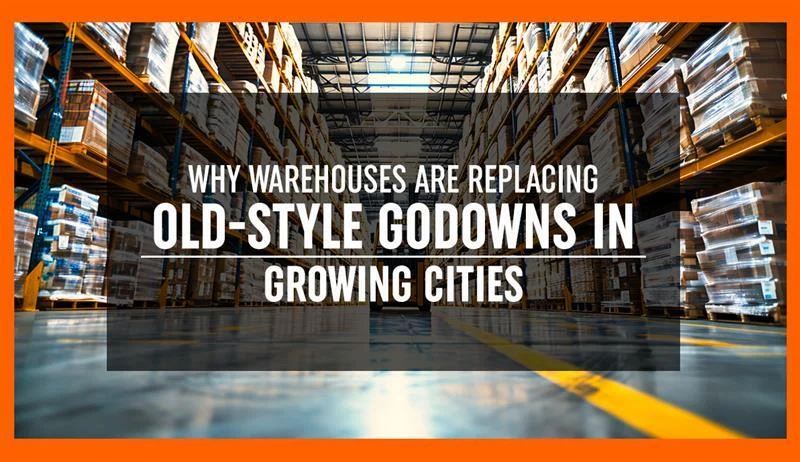
Cities in India are growing fast, and business needs are changing with them. Old-style godowns once worked well for basic storage, but today they feel slow and limited. Businesses now deal with faster delivery, online orders, and strict safety rules. They also need better control over stock and movement. This shift has made modern warehouses more useful than traditional godowns.
As urban land becomes costly, every square foot must work harder. Companies want spaces that support tech, speed, and scale. This is where warehouses fit better than godowns. From logistics firms to retail brands, many are rethinking storage choices. The change is clear in metro and tier-one cities across India.
How is a Warehouse Different From a Godown?
A warehouse is a modern storage space built for efficiency, safety, and speed. It usually has proper flooring, high ceilings, loading docks, and clear layout planning. Most warehouses support forklifts, racks, and digital systems for tracking goods. They also meet fire, labour, and building rules set by authorities. Warehouses are designed for large volumes and fast movement.
A godown is a basic storage structure used mainly for holding goods. It often lacks proper layout, safety systems, and modern equipment. Many godowns are older buildings with low ceilings and weak flooring. Manual labour is common, and stock tracking is usually done by hand. Godowns work for simple storage but struggle with modern supply needs.
| Feature | Warehouse | Godown |
| Design | Planned and modern | Basic and unplanned |
| Safety | Fire systems and rules | Limited safety setup |
| Technology | Digital tracking and tools | Mostly manual |
| Loading | Docks and equipment | Manual loading |
| Use case | Large-scale operations | Simple storage |
Why Warehouses Are Replacing Godowns in Growing Cities?
Growing cities face land shortage, traffic pressure, and higher demand for quick movement. A single warehouse can handle what several godowns manage separately. This reduces travel time, fuel cost, and delivery delays. For the city-based supply chains, this matters a lot.
E-commerce growth is one big reason behind this shift.
India’s e-commerce market is expected to cross USD 200 billion by 2030. Fast delivery promises need organised storage close to cities. Warehouses support sorting, packing, and dispatch under one roof. Godowns cannot handle this scale or speed easily.
Compliance is another key factor.
Cities now enforce strict fire, labour, and building regulations. Warehouses are built to meet these norms from day one. Many old godowns fail inspections or need costly upgrades. Businesses prefer warehouses to avoid legal and safety risks. This makes long-term operations smoother.
Technology also plays a major role in this change.
Warehouses support inventory software, barcode systems, and CCTV monitoring. This gives real-time stock data and reduces losses. Godowns depend on manual checks, which cause errors and delays. In fast-moving cities, accuracy is critical.
Labour efficiency pushes businesses toward warehouses as well.
Modern layouts reduce manual effort and speed up work. Forklifts, conveyors, and racks improve productivity. One warehouse team can do the work of several godown teams. This lowers long-term labour costs and improves control.
Location planning favours warehouses in urban growth zones.
Many warehouses are built near highways, ports, and industrial hubs. This improves city supply flow without adding traffic inside dense areas. Godowns are often inside city limits, causing congestion. Cities now prefer planned logistics zones over scattered storage.
Investment trends also show this shift clearly.
Developers focus more on warehouse parks than godown clusters. Businesses looking for a Warehouse for sale in Kolkata often get better facilities and returns. Warehouses attract long-term tenants and stable demand. Godowns struggle to match this value today.
When Should Businesses Use Warehouses and When Should They Use Godowns?
Use a warehouse when
- You need fast movement of goods with high order volume. Warehouses support quick loading, unloading, and dispatch.
- You run e-commerce, retail, or distribution operations. These need tech, safety, and space planning.
- Compliance and safety are important for your business. Warehouses reduce legal and risk issues.
Use a godown when
- You only need simple storage for bulk goods. Godowns work for low-movement stock.
- Your operations are small and local. Manual handling may still be manageable.
- Budget is very tight, and scale is limited. Godowns cost less but offer fewer features.
The Bottom line
Warehouses are replacing godowns because cities demand speed, safety, and smart use of space. Modern supply chains cannot rely on old storage methods anymore. Warehouses support growth, tech, and compliance under one roof. Godowns still have limited use, but their role is shrinking fast.
For businesses planning future expansion, the choice is clear. Understanding the difference between warehouse and godown helps in making the right call. As cities grow, storage decisions will shape cost, speed, and success. Choosing wisely today avoids bigger problems tomorrow.


