


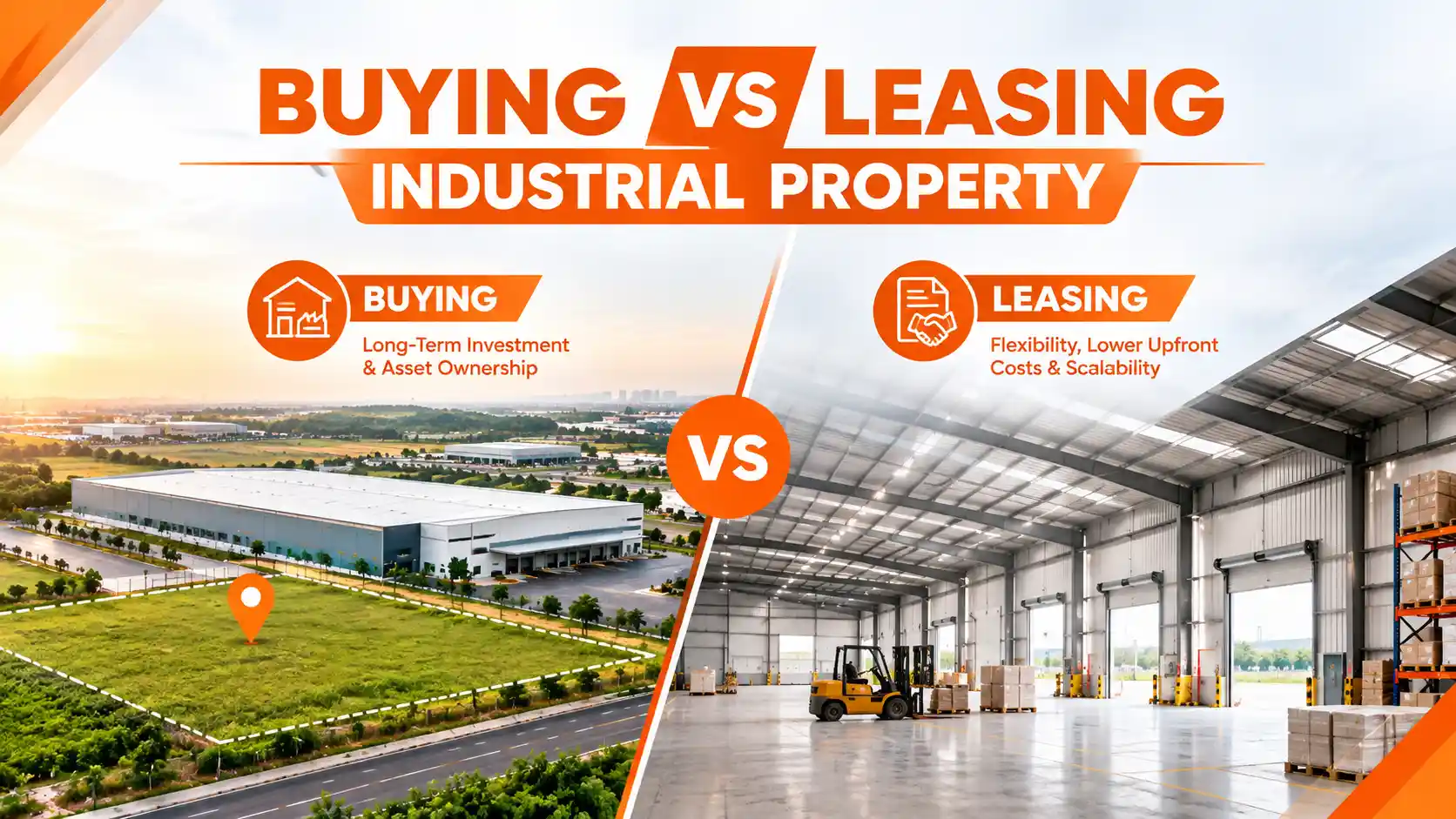
For companies considering warehousing, distribution, logistics, and manufacturing, the decision to lease or buy industrial property is critical.
Your buy vs lease decision reflects your capital availability, operational requirements, expected occupancy duration, and expansion needs. Companies looking for industrial property for sale should also focus on location, amenities, connectivity, and long-term property needs.
Buying Industrial Property
Acquiring an industrial property lets a business own the property and gain more control over its location. An owner can keep the property long-term and may be able to make changes or adaptations to the space, within regulations.
If you intend to move the business to roughly the same place for many years, then it is better to consider ownership. Leases may need to be renewed many times. An owner can modify the building, install equipment, and use the space more fully.
Sometimes, a purchase requires a significant upfront capital outlay. In addition to the purchase price, registration and tax costs, legal due diligence, maintenance, insurance, and potential refurbishment costs can add up quickly.
Leasing Industrial Property
Leasing lets a company lease industrial space instead of owning it outright. At Ganesh Complex, our experts believe leasing lets a company pay a fee to use the property instead of owning it, freeing up capital for equipment, inventory, employee salaries, or expansion.
Leasing also offers flexibility. A business may be expanding rapidly and need larger premises, or it may be venturing into new markets and not want to commit capital to property too early. Leases include certain monetary costs, as well as limits on modifications, use, renewal, and lease expansion. Review lease agreement details carefully before signing.
Buying vs Leasing Industrial Property
| Factor | Buying | Leasing |
|---|---|---|
| Initial investment | Higher | Generally lower |
| Ownership | Business owns the property | Landlord retains ownership |
| Long-term control | Greater | Depends on lease terms |
| Flexibility | Lower if relocation is required | Generally higher |
| Maintenance | Usually owner’s responsibility | Depends on agreement |
| Expansion | Subject to available land/property | May require relocation |
| Capital commitment | Significant | More manageable |
| Long-term asset | Yes | No |
What Should Businesses Consider?
Before deciding between buying and leasing, businesses should evaluate how long they expect to use the property.
Companies with long-term requirements will place greater importance on ownership and control, while businesses that need flexibility may prefer leasing.
Location
Location has always been a major consideration. For a warehouse in Kolkata, access to highways, ports, railways, suppliers, and the broader consumer market strongly influences logistics efficiency. As a result, industrial areas like Ranihati I and II, Raghudebpur, Uluberia, and other industrial and logistics corridors offer unique advantages, depending on the overall business.
Assess the overall condition and specifications of the property which you intend to consider for commercial usage. Consider water supply, ceiling height, loading equipment, car parking, drainpipes, vehicle access, fire safety installations, and floor durability.
Financial Planning Matters
Others simply compare the purchase price and the monthly rental cost. In the purchase alternative, take into account acquisition costs, costs of financing and taxes, maintenance and any other costs of ownership.
For a lease, consider issues like rent escalation, security deposits, maintenance charges, and renewal conditions. Sometimes, a financial adviser or property expert can help your business evaluate these costs.
Location and Future Growth
The other thing is your plans. If you plan to expand storage or production capacity, buying a larger industrial property might give you more control over the layout. Otherwise, leasing might allow you to transition quickly. So, when you search for industrial property for sale in Kolkata, consider not only whether a property suits you today, but also whether it can support your business operations tomorrow.
Final Thought
Whether you lease or buy industrial property, every decision will affect your finances and operations. Buying can guarantee ownership and continuous use, but leasing can be more convenient and may require less upfront investment. Make the decision based on your target market, how much you can spend, your type of business, how long you intend to occupy it and how you expect to grow. Consider the cost, inspect the property, and investigate the law.


