


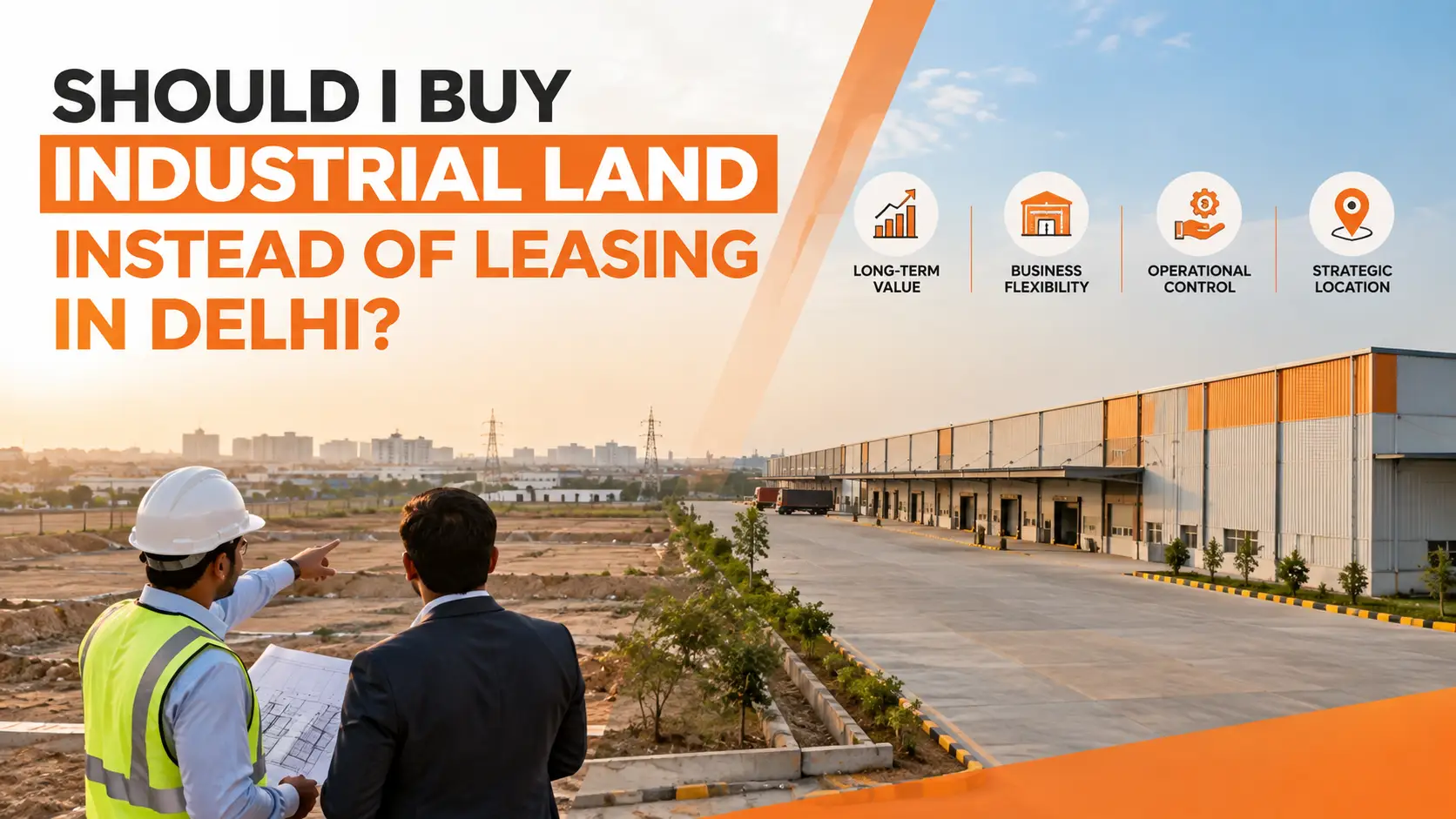
Business owners should assess why they want to buy industrial property, their investment horizon, and whether they have enough capital. Certain factors favour buying or leasing, and the final decision should consider the time value of money, total costs, asset ownership, capital availability, and long-term business plans.
Leasing reduces immediate costs but purchasing industrial land for sale in Delhi, leaves the landlord in control of the property, while buying requires more upfront capital but provides ownership and control. It also lets you build a long-term business asset. Before deciding, businesses compare the immediate and long-term financial implications of both options.
Buying Industrial Land for Sale in Delhi
At times, owning land in Delhi requires higher upfront costs, including registration fees, stamp duty, due diligence and legal verification, development charges, and applicable taxes. Once you own the property, your business will have more flexibility to develop or modify it.
Ownership eliminates the need to renew or revisit lease terms, and it can result in long-term appreciation or depreciation of the property. However, owning a land parcel is more appropriate when you plan to use it for many years. At times, land value can rise or fall completely depending on overall market conditions and location.
Industrial land can support businesses such as factories, warehouses, workshops, logistics services, and other commercial or industrial activities, as long as they are allowed on the property. The specific use of industrial land will vary depending on the property’s zoning, development guidelines and approvals, and other local authority regulations.
Advantages of Buying Industrial Land
- Greater control over the use and development of the property
- Long-term potential appreciation of the land parcel
- Stability for long-term operations
- Building an asset for the future
Allowed Uses of Land
Manufacturing units, workshops and storage, logistics warehouses or any similar industrial purposes. Other uses based on the type of land use permissible by the local planning authority, zoning regulations, and development permissions and consent. Leasing industrial property in Delhi requires low initial investment, making it viable for startups or expansion.
When renting
- It lets you focus on services rather than ownership assets and obligations.
- The leasing term can be more flexible when transportation and sales locations change, tax, border, or customs procedures change, or the workforce grows.
Disadvantages of Leasing Industrial Land
- Lease rents, security deposits, or rent escalation clauses can add up to higher total costs over the long run
- Managing and renewing the lease can be more complicated than owning a property
- Lease agreements may restrict modifications or improvements to the property
Leasing Industrial Property in Delhi
At times, leasing requires less upfront capital, making it attractive for startups, growing businesses, and companies that want to preserve cash for equipment, employees, inventory, or expansion.
Leasing also offers flexibility if your company needs to move quickly because of changes in transportation needs, workforce, customers, or growth. Moving at the end of a lease may be a less complicated process than selling the property.
Lease agreements often include rent escalation clauses, deposits, maintenance clauses, and property modification restriction clauses. So, before signing a lease, a business should review the lease terms and conditions, renewal terms, permitted business activities, maintenance requirements, and termination conditions.
Buy vs Lease: What Should Businesses Consider?
| Factor | Buying | Leasing |
|---|---|---|
| Initial investment | Generally high | Generally lower |
| Property control | Greater control, subject to regulations | Subject to lease terms |
| Long-term stability | High if the property meets future needs | Depends on renewal |
| Flexibility | Lower because selling may take time | Generally higher |
| Property appreciation | Owner benefits from potential appreciation | No ownership benefit |
| Maintenance | Usually owner’s responsibility | Depends on agreement |
| Expansion | Can modify/develop subject to approvals | Requires landlord approval in many cases |
When Buying May Make Sense
At times, buying may be worth considering when a company has sufficient capital, expects to remain in Delhi for a long term, and has already identified land that meets its operational and regulatory requirements. Ownership makes sense when the business requires customised facilities or expects to expand the site over time.
Sometimes it may not be worth buying for the anticipated appreciation. Look closely at the location, access, land title, zoning, infrastructure, planning approval, and even prospective business needs. Read more now to make an informed decision to buy or not.
When Leasing May Be More Practical
Leasing certainly makes sense if you face capital constraints, need more flexible space, or want a shorter lease term. You might be able to operate your business without a major property investment.
Engage in financial cost calculations by estimating the total amount of rent and other costs of occupation over the proposed lease period. Find the total ownership costs, including loans and interest, taxes, maintenance, development, and opportunity costs of invested capital.
Conclusion
Should I buy or lease? Not one size fits all. If you are setting up a location for long-term use, buying industrial land in Delhi is ideal so you can own the land and have greater control over its usage. However, if you want flexibility and lower upfront capital, a lease may be preferable. Perform legal title verification, zoning, infrastructure assessment, financial calculations, and other professional due diligence before choosing.
Contact Ganesh Complex now!
FAQ’s


